


A person sitting at home on Sunday evening. The room is quiet. Maybe the television is on, but they are not really watching. Their laptop is closed. Their phone lies next to them. Nothing urgent is happening.
And still, something feels off.
They are not in danger. Nothing has gone wrong. But their body is slightly tense. Their breathing is shallower. Their thoughts begin to orbit around tomorrow.
You might still be physically at home, but internally, you have already stepped into next week. The sprint board exists in your imagination. Slack messages not yet written, replay in your head. Conversations you postponed during the week quietly return.
Nothing has happened yet.
And still, your nervous system reacts.
This reaction is rarely about the work itself. Most engineers do not hate solving problems. Most tech leads do not wake up thinking, “I despise building systems.” The discomfort is more subtle. It lives in ambiguity, in unfinished emotional threads, in the quiet backlog of unresolved internal friction.
Throughout the week, you override small signals. A stakeholder shifts scope again, and you feel irritation. A meeting leaves you uncertain about expectations. You postpone a difficult conversation with a colleague. You sense that something in the architecture is fragile, but decide to handle it later. Each of these moments is small enough to ignore.
… so you ignore them.
Professionalism often means suppression.
But suppression does not mean deletion.
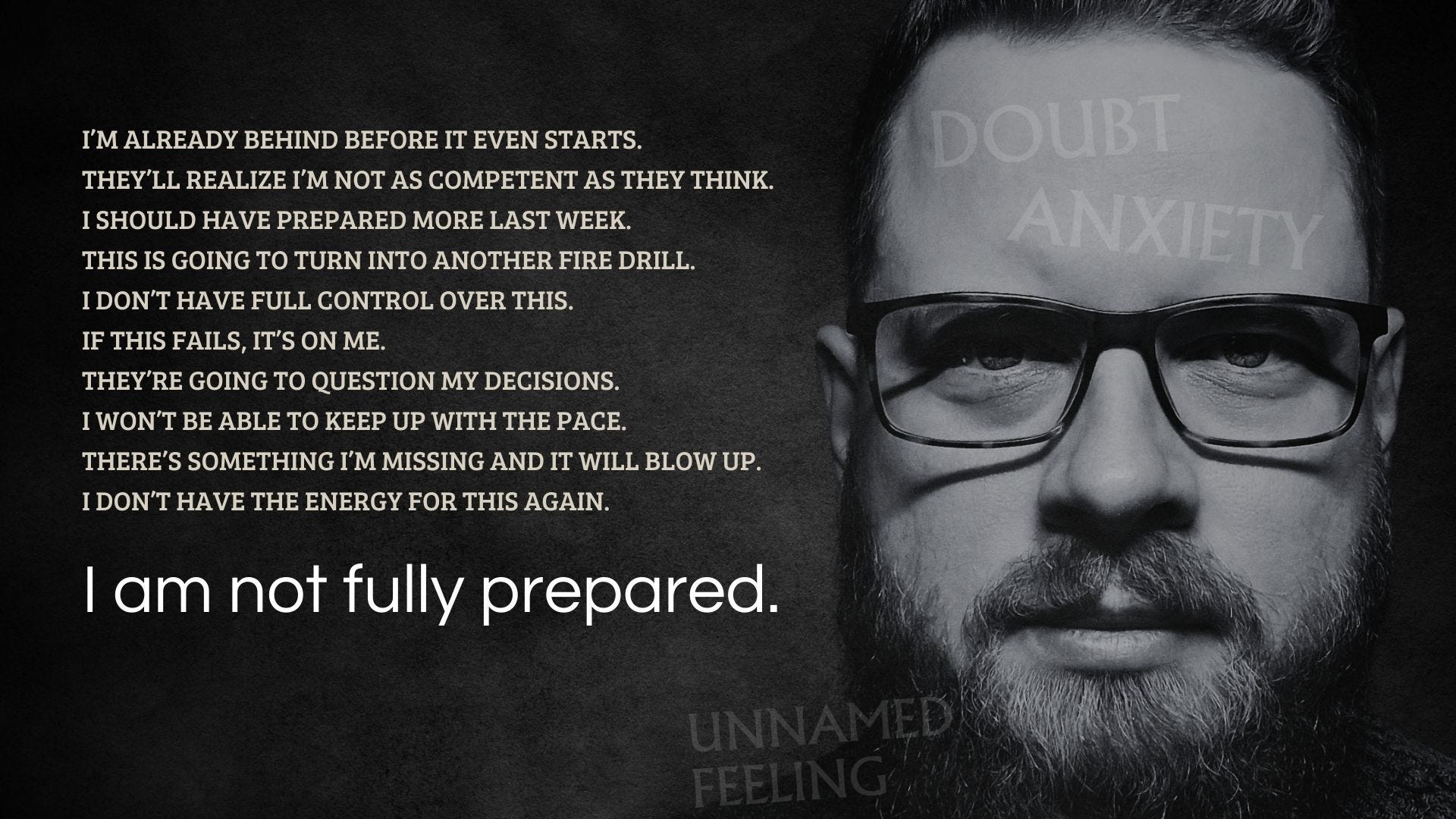
Emotional Debt – Very similar to technical debt.
What accumulates is not just technical debt. It is emotional debt. And emotional debt, like its technical counterpart, compounds when left untreated.
By Sunday, the calendar is not what creates anxiety. It is the interpretation of the calendar. It is the story layered over reality.
Reality might look simple: a handful of tickets, a planning session, a demo at the end of the week. On paper, this is manageable.
But the story whispers something else.
This sprint will derail.
They expect more than I can deliver.
That conversation will go badly.
I am not fully prepared.
Psychologically, this is predictable. The human brain is biased toward threat detection. The amygdala reacts faster than the rational cortex. When uncertainty rises, the brain fills the gaps with worst-case simulations. Research in cognitive psychology shows that ambiguity increases stress responses even more than known negative outcomes. The body prefers a defined problem over an undefined one.
In tech, ambiguity is everywhere.
Unclear scope.
Unspoken expectations.
Invisible power dynamics.
Social evaluation.
The nervous system does not distinguish well between physical threat and social uncertainty. Both activate similar stress pathways. Cortisol rises. Heart rate shifts. Attention narrows. You experience this as tension, restlessness, or dread.
When variables feel undefined, control feels abstract. And when control feels abstract, anxiety rises.
This is where avoidance begins. You delay opening the document. You tell yourself you will prepare for the conversation tomorrow. You distract yourself with something easier. Avoidance offers short-term relief. Behavioral psychology calls this negative reinforcement: removing discomfort strengthens the avoidance behavior.
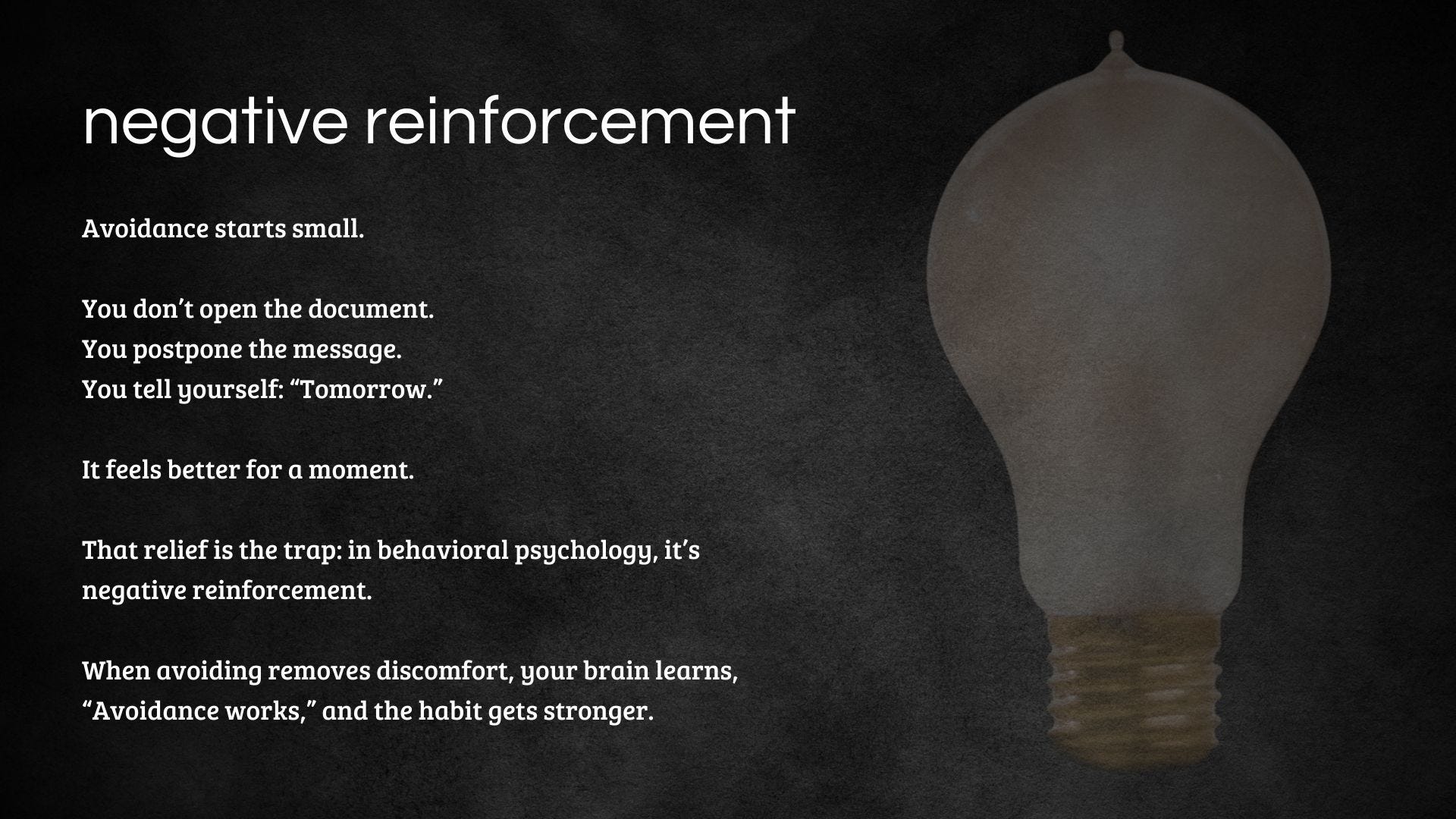
We can get out of this anxiety
“thoughts are not facts”
The loop becomes self-sustaining.
By the time Sunday evening arrives, you are not afraid of Monday.
You are carrying an unprocessed internal load.
The turning point is rarely dramatic. It does not require quitting your job or redesigning your entire life. It requires differentiation.
You must learn to separate what is happening from what your mind is projecting.
Reality is concrete. It can be written down. It has boundaries. It consists of tasks, meetings, constraints, and deadlines. The story is interpretive. It consists of imagined failure, assumed judgment, and predicted conflict.
Most of the emotional intensity surrounding Monday belongs to the second category.
When you externalize these projections, something shifts. The mind is no longer an unquestioned narrator. It becomes an object of observation. The moment a thought is written down, it becomes examinable. Once examinable, it becomes adjustable.
👉 This is not about positive thinking. It is about precision.
Cognitive behavioral therapy is built on this principle: thoughts are not facts. When you identify distortions, you reduce their emotional impact. Naming a fear activates different neural networks than being submerged in it. Language creates distance. Distance restores choice.
In tech culture, we are trained to debug systems, optimize processes, and refactor code. We rarely apply the same rigor to our internal operating system. We pride ourselves on rationality while ignoring the emotional layer that drives many of our decisions. Unprocessed emotions do not disappear simply because we are analytical. They settle into the background and manifest as tension, procrastination, or Sunday dread.
Regaining control does not mean eliminating uncertainty. It means increasing clarity where possible and consciously accepting what cannot be controlled. Some conversations need to be finished. Some expectations need to be clarified. Some commitments need to be renegotiated. Often, the dread of Monday signals that a boundary was not set or a decision was delayed.
Agency returns when you act on what you have been avoiding.
Sometimes this action is small: sending a message, scheduling a discussion, defining ownership explicitly. Sometimes it is internal: admitting that you are afraid of being judged, acknowledging that you care more about a project than you allow yourself to say.
Clarity reduces imagined threat. Completion reduces cognitive load. The deeper realization is this: if you consistently dread Monday, it is rarely because you chose the wrong profession. It is more often because you are allowing unexamined narratives to shape your emotional state.
The mind tells stories automatically. That is its function. But you are not required to believe every story it produces.
The Stoics understood this long before neuroscience. Epictetus wrote:
“Men are disturbed not by things, but by the views which they take of them.”
The event is neutral. The interpretation creates disturbance. This does not mean the event is irrelevant. It means your interpretation is decisive.
Enjoying Monday does not mean loving every task. It means entering the week without being dragged by unresolved internal tension. It means accepting where you currently stand, including your limitations, and choosing deliberate action instead of passive avoidance.
Acceptance is not resignation. It is the starting point for change.
When you accept the reality of your situation, you stop wasting energy arguing with it. That energy becomes available for movement. And movement, even small and imperfect, restores a sense of control.
The horror intro exaggerates a feeling many know too well. But Monday is not a monster.
It is a mirror.
It reflects what was left unfinished, unspoken, or unexamined during the week before.
If you want Monday to feel lighter, do not focus on motivation. Focus on clarity. Separate reality from story. Finish what you postponed. Name what you fear. Reduce ambiguity where you can. Consciously accept what you cannot change.
As Marcus Aurelius wrote, “You have power over your mind, not outside events. Realize this, and you will find strength.”
Control is not the absence of uncertainty.
It is the presence of a deliberate response.
Your chance to change something about yourself: Reality vs Story
When Sunday pressure builds, don’t try to “motivate” yourself.
Differentiate.
Take a sheet of paper and draw two columns.
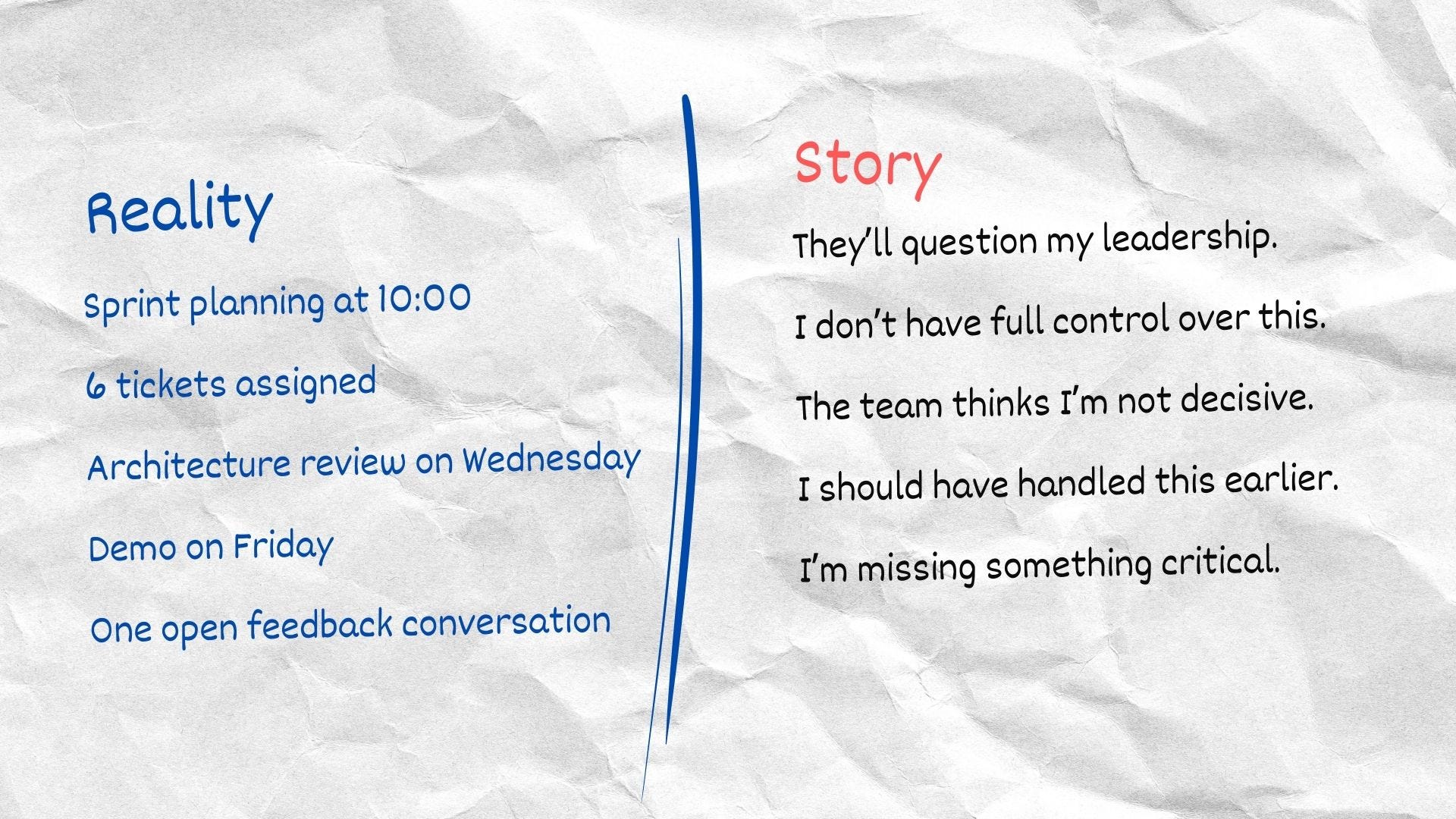
Column 1: Reality
Write down only what is objectively true about next week.
Meetings. Deadlines. Conversations. Deliverables. Constraints.
No interpretation. No adjectives. Just facts.
Example:
Sprint planning at 10:00
Architecture review on Wednesday
Demo on Friday
One unresolved 1:1 conversation
Column 2: Story
Now write what your mind is adding on top.
Fears. Predictions. Interpretations. Catastrophic thinking.
Example:
“This sprint will fail.”
“They expect more than I can deliver.”
“I’m not fully prepared.”
“That conversation will go badly.”
This separation is powerful.
Most anxiety lives in the second column.
Why Journaling Helps
When thoughts stay in your head, they feel like reality.
When you write them down, they become objects.
Psychologically, this creates cognitive distance. You shift from being inside the thought to observing it. That activates more rational processing and reduces emotional intensity. Research on cognitive-behavioral therapy shows that labeling and externalizing thoughts can weaken their grip.
Journaling does three things:
It exposes patterns.
The same 2–3 fears repeat every week.
It reduces ambiguity.
Vague dread becomes specific and manageable.
It restores agency.
Once written, you can act: clarify, prepare, renegotiate, accept.
You don’t need pages.
Five minutes is enough.
Clarity reduces imagined threat.
And control begins the moment you separate reality from story.
Mentoring Session: Self-Mirror-Journal – Practise Self Mastery

“Ask yourself the question: Can you be honest with yourself?
📍Question of the day: What do you personally do to reduce the pressure that builds up before a new sprint or workweek begins?
— Adrian


