


Most people don’t lack ambition. They lack signal.
They call everything “potential” and then wonder why nothing moves. The truth is more straightforward and a bit more brutal. Potential is a possible reality that doesn’t exist yet, but can exist through you.
Not through vibes, not through wishful thinking, not through “one day” and primarily NOT through new year’s resolutions 😀 – Please…
Through you, every day, by discipline.
The Stoic filter: where does this live?
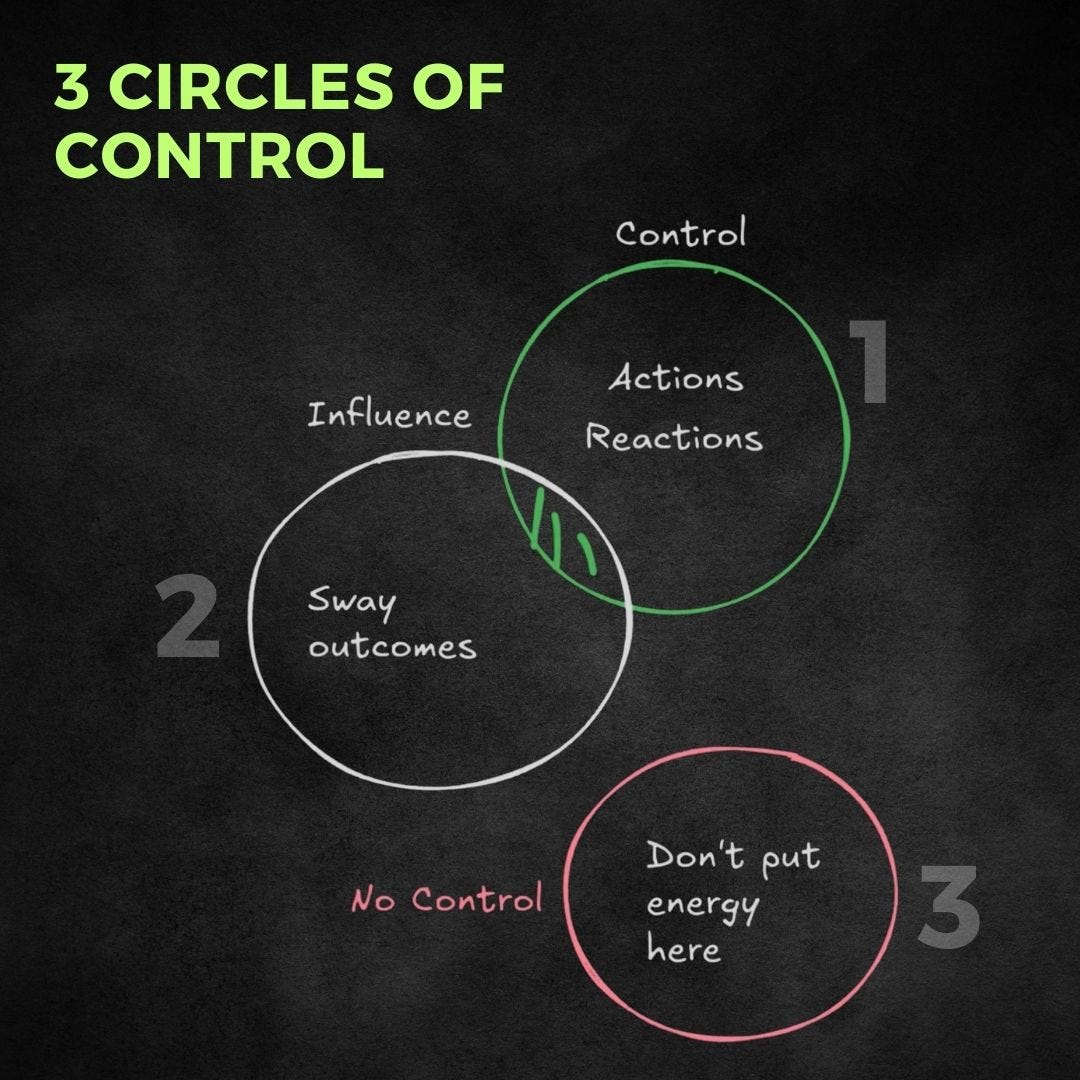
When I try to figure out if something is real potential or just dreamery, I run it through a Stoic lens:
Circle 1: Control. What can I do, decide, practice, ship, say, stop, start?
Circle 2: Influence. What can I shape through conversations, systems, incentives, and feedback loops?
Circle 3: No-control. What I can’t steer directly, especially not with ego and effort. Avoid putting time into the things in 3.
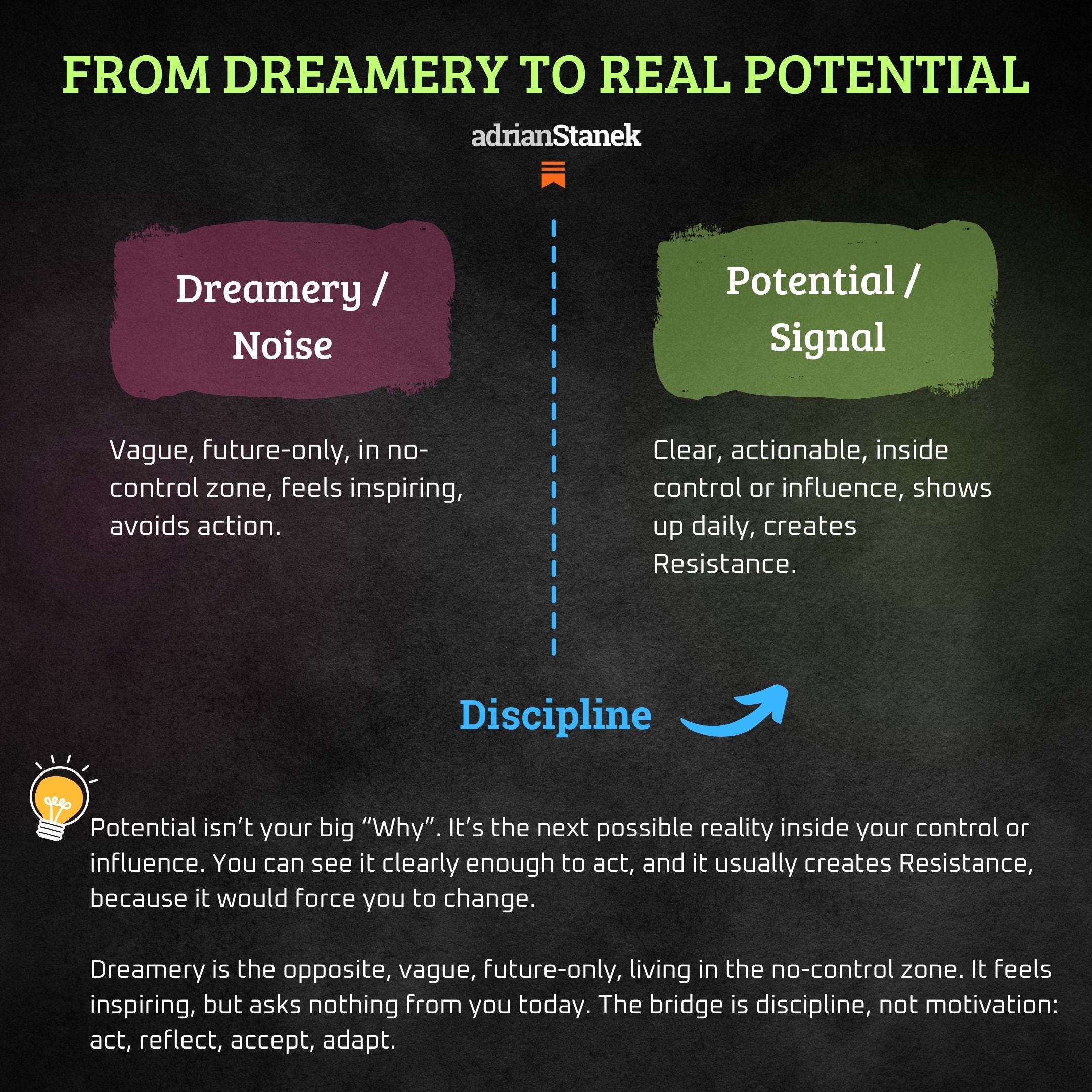
Potential lives in Circle 1 and 2.
Dreamery lives in Circle 3, and she loves to dress up as “vision”.
If you tell me you plan to “become a billionaire” or “I want to be the next Tony Robbins”, I’m not judging your hunger. I’m judging the signal-to-noise ratio. For most people, it’s not a plan, it’s a fantasy costume.
In the stoic sense: It’s not change, it’s decoration.
If you tell me you plan to become a strong software engineer, a respected tech lead, or a calm operator as a founder, that is different. That is a possible reality where your conscious mind and your subconscious mind can agree: “Yes, this is doable, if we become the person who can do it.”
That agreement is the quiet core of real potential.
For more information about how to handle the 3-Circles in a stoic sense, read this mentoring piece:

Potential is NOT your “Why.”
Your “Why” is essential. It gets you out of bed. It gives meaning when it’s hard.
But your “Why” is not your potential. Potential shows up closer to the ground.
Daily. Sometimes weekly.
You can see it. It’s clear enough to act on. There is a path, even if it’s incomplete, and you can take the next step without needing to solve the entire mountain.
And here’s the part people miss: when potential is real, you often feel Resistance.
Not because it’s wrong, but because it would change you.
Change triggers a war in our heads; we suddenly get tired, busy, doubtful, distracted, “not today”. The more critical the potential, the more creative your mind becomes at protecting the old identity.
That’s why dreamery is so seductive; it feels inspiring, but it asks nothing from you today.
Are you willing to make a change?
Are you willing to put in the time and effort?
Are you willing to become another person?
Then you need to develop the discipline to change every day toward your Why and put in that hard work every day. Not into a distant dream, next year.
A CTO example I see all the time
I mentor a bunch of CTOs right now, and there’s a pattern that repeats almost perfectly.
Many of them can feel a real potential:
To become a strategic, influential leader, someone who turns a messy org into a place where people do great work, where shipping becomes normal, where the system supports quality instead of fighting it.
That potential is clear.
But the path is noisy. The signal is missing. It’s unclear what to do first, what to stop, what conversations to have, and how to rewire the environment without burning political capital.
So what happens?
Not-yet-there-CTOs retreat into what they can do best: code reviews, architecture, “just quickly checking the PRs”, sometimes even opening the IDE and writing code again.
It feels productive, but it’s procrastination. It postpones the work they should do.
Because a CTO cannot control an environment of 20 developers as a single person in an IDE.
That was the past, when you were leading a group of 5 developers.
Accept it. Adapt. Look forward.
Your potential is no longer a feature; it’s the environment where 20 people can build a product without you becoming the bottleneck. In fact, a climate in which you aren’t necessary anymore to be present.
“I know I should be leading more, but I’m drowning, and at least in code I feel useful. The org feels chaotic, so I try to fix it by fixing the technical details.”
That sentence right there is the border between potential and dreamery.
The potential is leadership and system design in Circles 1 and 2.
The dreamery is the illusion that you can stabilize a whole org by being the hero in Circle 3.
The “potential practice” that actually works
This is the uncomfortable truth: you don’t discover your potential by consuming content. (Read one please 😀).
You discover it by doing self-leadership. (What you start to do right after this article).
That means you do work on yourself, not in an abstract way, but in a disciplined feedback cycle.
First, you get honest about who you are right now, not who you wish you were. Then you define who you need to become. Then you locate the potential, the real, actionable possibility that sits in your control and influence. Then you build the signal: the next steps that turn it into reality.
This is how it sounds in my head:
A) Assessment: Who am I right now? What do I repeatedly do when I’m under pressure? What do I avoid? Where do I hide?
B) Definition: Who do I need to become? What traits, habits, and boundaries would that person have?
C) Signals: What is my potential, right now? Not in ten years, right now, what possible reality is available to me if I change?
D) Action: What do I do next to make it real? What is the following conversation, the following constraint, the following system change, the following uncomfortable action?
E) Resilience: Discipline in both directions. Do at least the baseline today; also, don’t fall for shiny object syndrome. Stay on the path towards your signal!
Potential requires three things at the same time:
Focus on signals, feedback from reality, and discipline.
In simpler words: Act, reflect, accept, adapt – daily, with your goal in mind.
That’s the loop. And yes, it’s boring sometimes. It’s also the only thing that works.
The question that separates the two
Here’s the filter I want you to use today:
If you had to prove your potential is real within 7 days, what would you do differently tomorrow?
❌ If your answer is vague, it’s dreamery.
✅ If your answer creates Resistance, but also creates clarity, it’s probably real.
And if you keep “getting busy” with the thing you’re already good at, you already know what’s happening. Getting busy is procrastination.
You’re choosing comfort over change.
—Adrian

Mentoring Session: Self-Mirror-Journal – Practise Self Mastery

“Ask yourself the question: Can you be honest with yourself?