


I have been in tech leadership long enough to recognize the same failure pattern in a hundred different outfits. You schedule a meeting, you show up with a list of “important points”, you go through the numbers, the roadmap, the risks; everyone nods, no one interrupts, you leave with a strange feeling of progress. Then nothing moves.
A week later, you hear the sentence that should make every leader flinch:
“We discussed this.” – You did not.
You delivered a monologue. If there is no feedback loop, it is not communication; it is drilling.
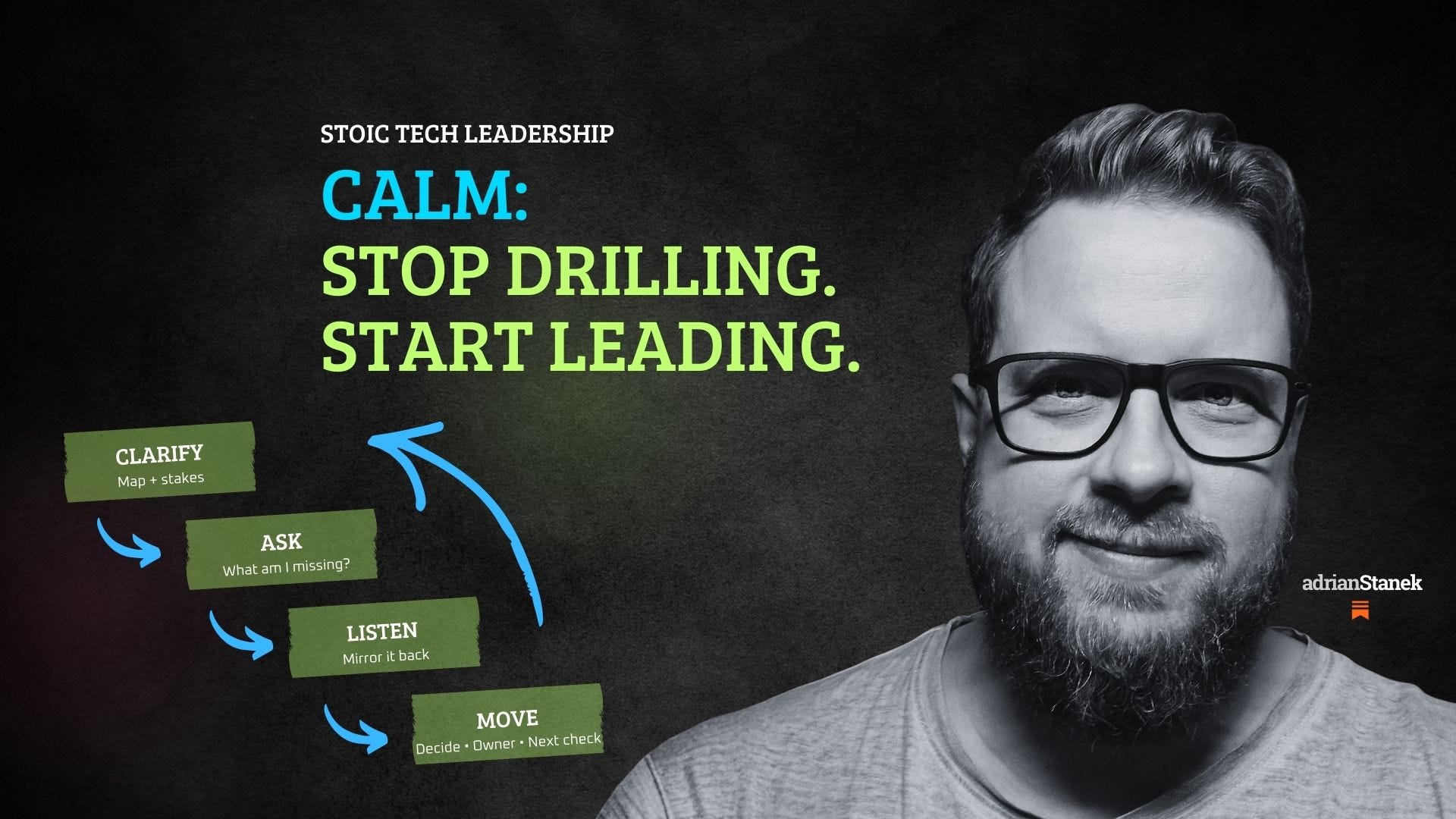
Stoic Tech Leadership starts here, not in slogans, but in intervention; in the moment where you notice, “I am broadcasting,” and you choose instead to create shared meaning. Communication is not message delivery; it is meaning made common. Leadership is not a role; it is motion. No motion, no leadership.
1. The Stoic definition that matters in practice
When I am not sure about a concept, I go back to the root. Communication, from the Latin communicare, means “to make common”, “to share”. That is not poetic; it is mechanical. A message is not communication. Communication is the loop: I send something, you react, I adjust, we arrive at something we both understand and can act on.
The stoic angle is simple and demanding. My responsibility ends at clarity and stance; it does not include managing your emotional reaction. At the same time, it includes respecting your dignity and creating a space where you can respond without fear. So the stoic leader does two things at once: speaks with calm clarity, and builds the feedback loop on purpose. This is not softness; it is practised precision.
Stream about Leadership Communication with Daniele Ponzo.
2. Why monologue leadership fails in tech
If your leadership communication is a monologue, you are not creating signals; you are adding noise.
Tech makes drilling look productive. We love status updates, dashboards, and the idea that if we expose enough information, alignment will magically appear. It does not. I have seen it in product meetings with business stakeholders where developers drift away; not because they do not care, but because they cannot locate themselves in the conversation.
You can watch it happen: someone starts thinking about five open tickets, someone starts doing “just one quick thing” in the background, someone turns into a talking-head silhouette with the camera off, and suddenly you are speaking into a vacuum. Not because they are lazy, but because you did not give them a role. Humans do not move without meaning.
In uncertain times, it becomes worse. Fear increases noise. The more insecure the market, the more people scan for signals; when they cannot find any, they substitute interpretation, rumors, and personal anxiety. If your leadership communication is a monologue, you are not creating signals; you are adding noise.
“And be silent for the most part, or else make only the most necessary remarks, and express these in few words.” Epictetus, the Manual 33 1
3. Dialogue is not a vibe; it is a system
The simplest way to think about dialogue is this: your job is not to deliver information; your job is to build a shared map. A shared map produces motion; a monologue produces, at best, compliance.
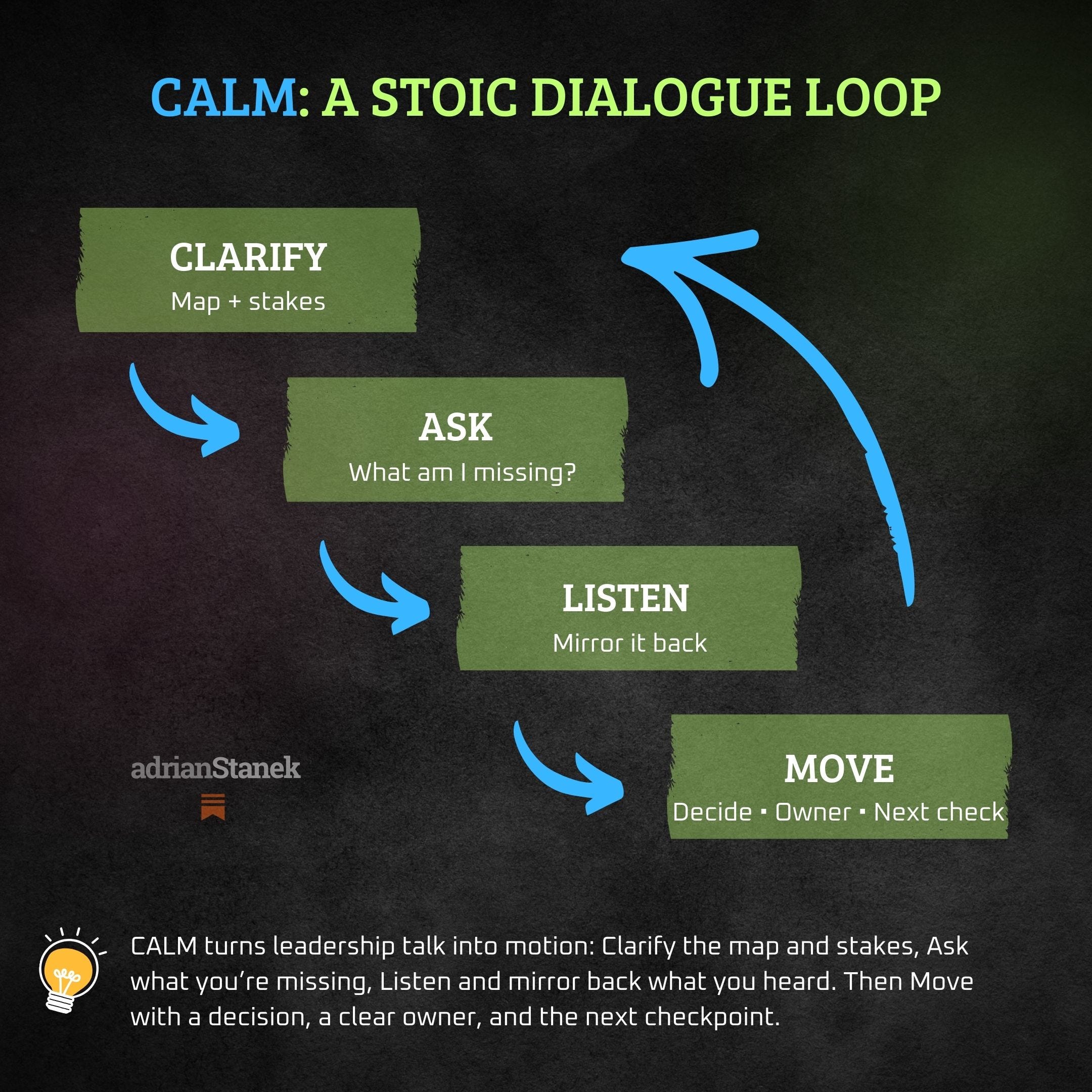
Here is the loop I use when I want motion, not nodding: frame the situation in one minute; invite a response with a real question; listen without defending; reflect what you heard in their words; commit to a decision, an owner, and a next checkpoint; check understanding.
If you skip the invite, you are drilling. If you skip the reflection, you are collecting opinions rather than building shared meaning. If you skip the commit, you created a nice conversation that goes nowhere.
CLARIFY: “Here’s the map and the stakes.”
ASK: “What am I missing?”
LISTEN: “Say it back in your words; I’ll mirror it.”
MOVE: “Decision, owner, next check.”
4. The leader’s three tools for dialogue
Dialogue does not mean you talk less; it means you talk differently.
Tool 1: Story, make the journey visible
In Germany, calling something a “story” can sound like you made it up. In reality, a story is a structure; it is the shortest path from information to meaning. A leader is always describing a journey, even in the most boring meeting, especially in a boring meeting.
The practical pattern I use is simple: where are we right now, what is the tension, what is at stake, what choice is in front of us, what will we do next, and what will that change.
I do this even when the topic is “numbers”, because numbers without stakes are sleep medicine. So instead of “Here are the numbers”, I open with something like this: “We are on a journey to ship faster without breaking trust; the tension is that our current release process is creating fear; the stake is customer confidence and our own momentum; the choice is whether we invest in continuous delivery practices now or keep paying the rework tax; today we decide what we stop doing so we can start doing what matters.”
Now developers and business people can locate themselves; now there is a story; now there is motion.
Always remember to make the people around the protagonists of the story.
Tool 2: Voice, authority without aggression
Most leaders think authority comes from speed, volume, or cleverness. It does not. Authority comes from calm clarity; you can feel it in the room when someone speaks, and you stop multitasking. That is not charisma; it is pacing, intonation, and strategic pauses. A practical intervention I teach myself is this: every time I think, “I must say this perfectly,” I slow down and pause.
A pause is not empty space; a pause is an invitation. Use three kinds of pauses: before the point, to collect attention; after the point, to give weight; after the question, to create space for someone else to step in. If you never pause, you are not communicating; you are performing.
Tool 3: Empathy, precision targeting
Empathy is not about agreeing; it is about understanding what the other person can receive. It is the leader’s targeting system. Before I speak, I try to answer one question: “What are they protecting right now?”
A developer might be protecting focus; a product person might be protecting credibility; a founder might be protecting runway. If I ignore that, my message lands like a bullet; it hits, but it does not connect. If I respect it, I can make the same message land as an invitation.
If you take a moment during a regular workday with meetings and discussion you can see this situation daily. We need to become better at this. In fact, this is a key ingredient in developing the work culture we all want.
5. The meeting rewrite: from numbers to movement
Let me make this concrete. Here is the meeting format that creates drilling: open call; “quick update”; twenty minutes of metrics; ten minutes of opinions; no decision; everyone leaves with vague anxiety. Now here is the dialogue version, and it fits into ten minutes.
The Stoic Dialogue Meeting Template
Context (20 seconds): why we’re here, why now.
Stakes (20 seconds): What happens if we do nothing?
Map (30 seconds): two options, tradeoffs included.
Invite (30 seconds): one real question, for example: “Where will this fail?” “What am I not seeing?” “What cost are we ignoring?”
Commit (30 seconds): decision, owner, next checkpoint.
Then stop. Numbers can be an appendix; the meeting is for meaning and motion.
6. One-on-ones: the smallest unit of dialogue leadership
A stoic intervention is to treat the one-on-one as a coaching session, not as administrative work.
One-on-ones are where leaders either build trust or build resignation. Most one-on-ones fail because they are treated as a ritual: same questions, same shallow answers, no movement. A stoic intervention is to treat the one-on-one as a coaching session, not as administrative work.
Here is my practical 20-minute structure: 5 minutes: what matters this week, in your words; 10 minutes: one problem, one decision, one next step; 5 minutes: development, skill, scope, ownership. And the questions that create motion:
“What are you avoiding?”
“What would good look like in two weeks?”
“Where do you need my protection, where do you need my push?”
“What is the smallest commitment you can make today?”
If you talk 90 percent of the time, it is not a one-on-one; it is a lecture.
👉 Mentoring advice for leaders: “Two weeks” is actually way too long, but I understand that most of you don’t have the structure right now to talk to everyone every day. But remember, the best teams work directly together. So in a team, these kinds of conversations must happen daily and shouldn’t be One-on-ones per se.
7. The discipline: train it like a craft
People ask for the perfect ratio of talking and listening. I do not believe in a golden number; I believe in a golden rule: if there is no exchange, there is no communication. Here is the practical habit that changes everything.
Record yourself, not to become an influencer, but to become observable to yourself. Record a 60-second clip answering one prompt: “What is the journey we are on right now?” Then watch it back. Do you have a clear frame? Do you have stakes? Do you invite feedback; do you end with a commitment?
Add the timer. Give yourself 90 seconds, then 60. You will feel pressure; that is the point. Under pressure, you speak as you were trained.
Add reality. Exchange one recording with one person; give each other feedback. This trains the feedback loop, not just your monologue.
8. The failure modes I still catch in myself
I am not writing this from a pedestal; I still catch myself drilling. The common failure modes are predictable, and so are the interventions. If you over-talk, ask a question every 60–90 seconds. If you do fake dialogue, reflect what you heard before adding your view. If you over-index on empathy and lose stance, state the decision and the why, then invite critique. If cameras are off and you lose signal, make check-ins explicit, summarize, and ask for confirmation.
👉 Make it visible to yourself, so you can become aware of your mistakes and shortcomings. Only by doing that do you get the chance to accept who and how you are. Then dare to make a change. It’s the same practise like champions train for their competitions.
9. The stoic standard
it is being calm so you can be precise.
Stoic Tech Leadership is not being calm for aesthetics; it is being calm so you can be precise. Your job is to create shared meaning that enables motion.
That requires story, voice, empathy, and discipline.
Stop drilling; start leading. Here is the simplest test.
After you speak, can the other person respond in a way that changes the shared map? If yes, you communicated. If not, you delivered a monologue.
—Adrian

https://en.wikisource.org/wiki/Page%3ADiscourses_of_Epictetus_volume_2_Oldfather_1928.djvu/527
In most industries, majority of meetings are absolutely useless. A way for people to massage their egos, tick the box to say 'we discussed this' like an audit trail etc. This post is spot on. Communication requires an uplift, we need to get better at bringing people together, listening to each other actively vs just as show.
Love the system you have designed! Think it needs to be viral!