


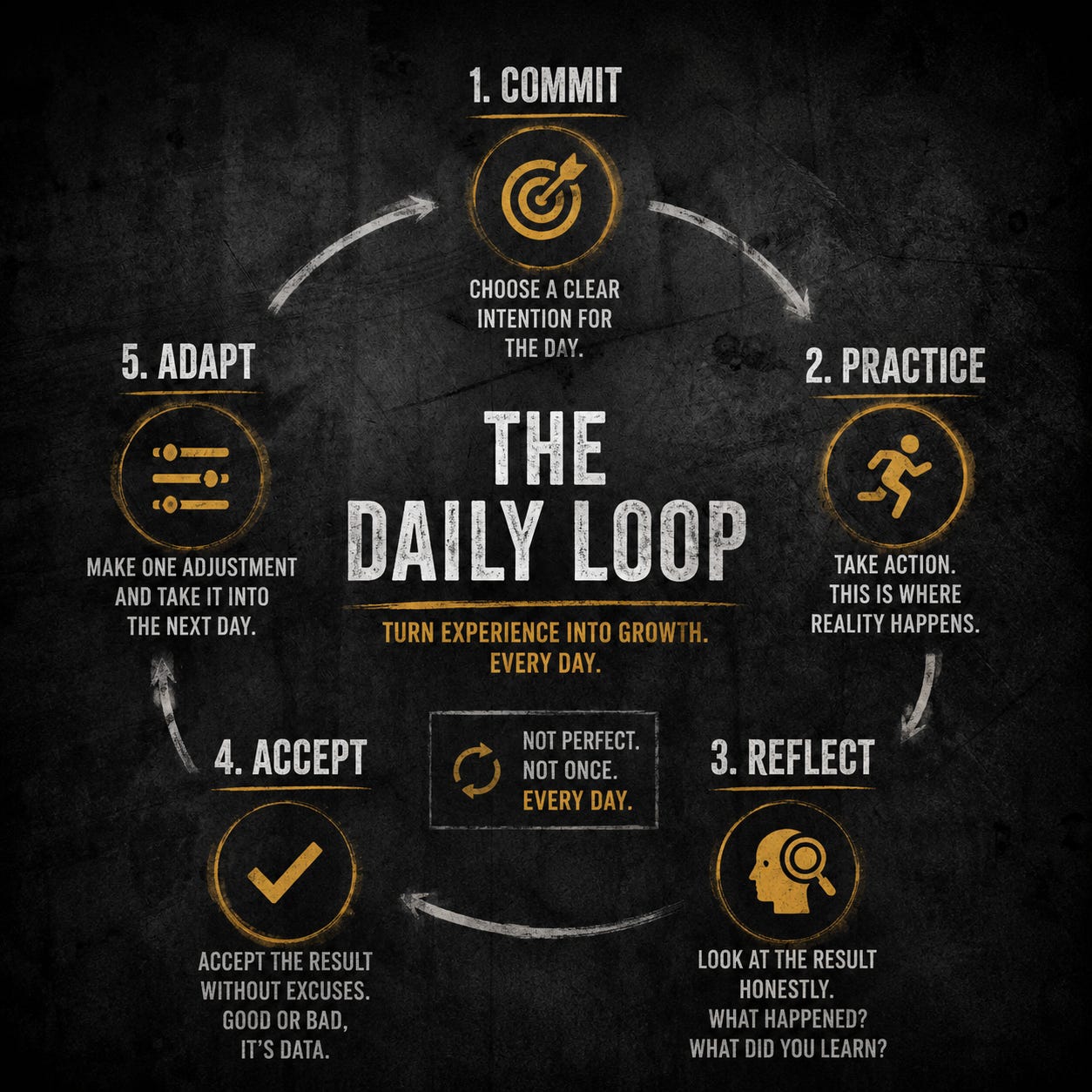
There is a simple loop that teaches you who you are: commit to something, practice it, reflect on the result, accept what happened, and adapt for the next day. It sounds almost too simple, but that is usually where the useful things hide. You do not understand yourself by thinking about yourself in theory. You understand yourself by watching what happens when you act.
A commitment reveals intention.
Practice reveals character.
Reflection reveals truth.
And here we can learn to become honest with ourselves. Even today, I realize how easily I get tricked by my own mind sometimes.
The difficult part is not the commitment itself. Many people can decide something in the morning. The difficult part is looking honestly at the result in the evening. Did I do what I said I would do? Did I act the way I wanted to? Did I become more useful to the people around me, or did I create more noise, more pressure, more confusion?
If the result was good, you have evidence. You learned something about yourself that is worth repeating. If the result was bad, you have a signal. Not a reason for shame, not a reason for self-hate, but a reason to change something. In both cases, the day gives you material for the next day.
That is why this cannot be a once-in-a-while exercise. It has to become daily. Not because every day needs to be dramatic, disciplined, optimized, or heroic. You do not need to run every morning, take cold showers, or copy someone else’s routine. But you do need some form of honest contact with yourself. Without that, you slowly lose the ability to see your own patterns.
And when you cannot see your patterns, other people have to live with them.
That is where self-reflection becomes more than personal development. It becomes a moral responsibility. If you do not know how your actions affect your mind, your emotions, your decisions, and the people around you, then you are moving through life half-blind. You may still be productive. You may still be intelligent. You may still be successful from the outside. But you are not necessarily becoming someone worth following.
That question matters to me: am I a person worth following?
Not in the cheap social media sense. In the human sense. Am I someone who makes the room clearer? Am I someone who contributes? Am I someone who can be trusted under pressure? Or am I someone others need to manage, tolerate, or recover from?
This is why I use my Mirror-Book. It is a simple journaling technique I use in the morning and in the evening. Sometimes I use it outside, after running or walking, because movement often brings thoughts to the surface. But the important part is not where I write. The important part is that I write honestly.
The book is only for me, and because of that, I can be brutally honest in it. I can write down where I acted badly. I can write down where I was unfair, reactive, arrogant, avoidant, or weak. Not to punish myself, but to recognize the pattern. Once the pattern is visible, it becomes possible to intervene earlier the next time.
That is the real value of reflection. It turns vague discomfort into language. It turns language into recognition. It turns recognition into a different action.
Digital tools can help with this. I have built apps for this myself. But writing by hand still has a different weight for me. A 2024 EEG study published in Frontiers in Psychology found that handwriting produces stronger brain connectivity than typing, particularly within networks associated with learning and memory. That does not make handwriting magic, but it supports something practical: when we write by hand, we process differently. The thought slows down. The body is involved. The sentence becomes harder to escape.
Mentoring Session: Self-Mirror-Journal – Practise Self Mastery

“Ask yourself the question: Can you be honest with yourself?
And that is what good reflection does. It removes the hiding places.
“Know thyself” is an ancient phrase, but it is not decorative. It is not something to put on a wall and admire. It is a practice. You know yourself by committing, practicing, reflecting, accepting, and adapting. Again and again.
Because if you do not understand yourself, you will never truly understand others. And if you never look at what you are becoming, you may become the problem without noticing it.
—Adrian


